Skip to content
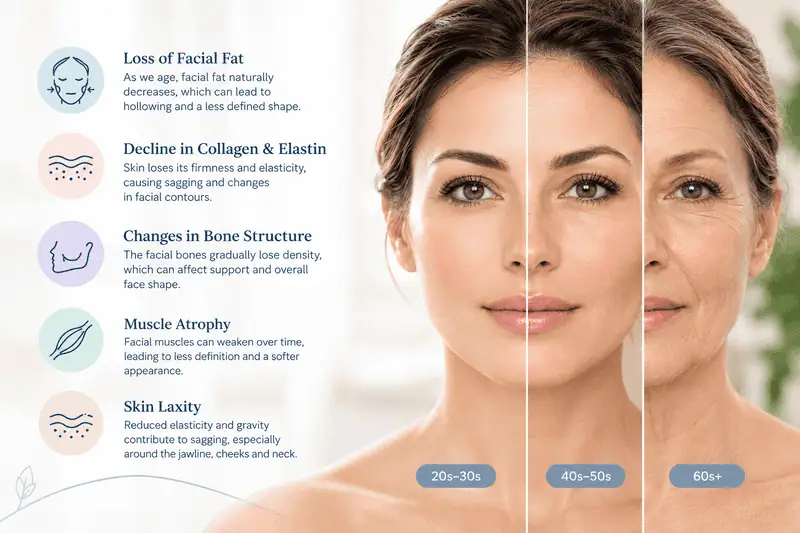
Table of Contents
When you look at your reflection from a certain angle, it can look a bit odd—not that you’ve gotten older, exactly, but that you look different. Your cheeks sit lower than they used to, and your jawline has softened, even though your weight hasn’t changed, which makes it hard to explain. At Preva Aesthetics, we help you better understand facial aging and what you can do about it.
Can skincare undo facial bone loss?
Not at all, & it is better to state that directly. Since bone changes happen beneath all the other layers, no creams, serums, or facial treatments can reach them. This is a structural change, mostly determined by genetics rather than anything you have or haven’t done. Skincare can improve skin quality, but it’s the layer most influenced by your daily habits.
Your Face Changes Shape Because Its Foundation Changes
Your face isn’t made of a single material; it consists of five layers stacked one on top of another, and each layer ages on its own timetable.
All of the skin, fat, muscle, ligament, and bone change, but four components determine your real shape: the bone beneath, the deep fat layers on top of it, the ligaments that hold everything in place, and the collagen and elastin in the skin. That’s what is meant by changes in facial structure with age. The surface merely represents the outermost layer of all these layers.
The simplest way to imagine the facial aging process is that a young face has its volume positioned high & broad across the cheekbones, while an older face has that same volume lowered and narrowed, directing it toward the jaw and chin. Nothing has vanished; it has just moved.
The Facial Skeleton Shrinks & Shifts
Your facial bones also change, and these changes are uneven. The maxilla, your upper jaw, gradually loses its forward projection. The eye sockets become wider, and the edge of the lower jaw loses some of its original sharpness.
Less bone means less support, so the soft tissue on top has less to hold it up and in place and thus drops down. This is why the cheeks flatten, and the area under the eyes develops a hollow in people whose weight has not changed over the last twenty years. Much of the facial volume loss is entirely unrelated to anything you have or have not done.
We tell patients this plainly because it matters. Bone changes are structural, and no cream or facial treatment can affect them, so we don’t say anything else to that effect.
Facial Fat Does Not Just Disappear, It Moves
Facial fat isn’t a single, uniform layer; it sits in separate compartments, like pockets, & these compartments age at different rates.
The deep pockets in the middle of your face generally shrink and drop downwards, while the fat in the lower part of the face and beneath the chin usually remains in place or increases. This is known as facial fat redistribution, and it’s why patients find the changes in their own faces so confusing: they can look hollow in one area and fuller in another at the same time.
Ligaments Loosen, and Gravity Does the Rest
Retaining ligaments are small fibrous anchors that attach your facial tissue to the bone below, keeping all the parts in place during the first few decades.
When the tissue relaxes, the part it was holding begins to settle. Where this settling tissue meets a ligament that is still firmly attached, it piles up above it. This is why nasolabial folds & early jowling occur, and why tightening the skin alone rarely corrects them.
This is because years of facial expressions affect it; the muscles cause the soft tissues in those areas to shift, which is one reason loss of facial definition typically starts to fade in the lower one-third first.
Skin Quality Changes on a Separate Timeline
Starting in your twenties, collagen and elastin production begins to slow down & continues to do so. The skin becomes thinner and can no longer bounce back as it used to.
Thin skin also hangs and settles differently over a foundation that has already changed. So facial skin laxity doesn’t just create a problem on its own; it makes the underlying structural changes more noticeable. The same bone and fat alterations appear much more prominently on skin that has lost its ability to recoil.
This is also the layer that has the greatest impact on everyday life; sun exposure, smoking, short sleep, & prolonged stress all accelerate its development. It is a major reason why two people of the same age can appear so different.
What You Can Actually Support, & What You Cannot
The only thing we can truly back is skin quality, and that shouldn’t be a consolation prize. The Microneedling Facial creates small, precise channels in the skin, stimulating your body’s natural repair process and collagen response in the weeks afterward. Results develop slowly rather than appearing all at once, and they differ from person to person.
The Microneedling with PRF Facial uses platelet-rich fibrin, obtained from a small amount of the patient’s own blood, to promote the same healing & collagen response. Because the aesthetic use of platelet concentrates is still under ongoing research, we set clear expectations when patients ask about it.
For the layer you have the most say over, consistency does more than intensity:
- Daily sun protection, which counts double at altitude
- Medical-grade skincare, including the Alastin and ZO® formulations we use in our Signature Facials
- Steady maintenance instead of occasional catch-up
A consultation is only useful when we identify the specific layer causing your concern. When you are looking at Facial Aging Treatments in Denver, CO, start with that option.
Ready When You Are
Your face tells a structural story, not a story of neglect. The team at Preva Aesthetics can help you sort out which layer of Facial Aging is behind what you are seeing and what is genuinely worth supporting. Book a consultation and Understand What’s Changing in Your Face Today!